 Machine à blocs de tigre

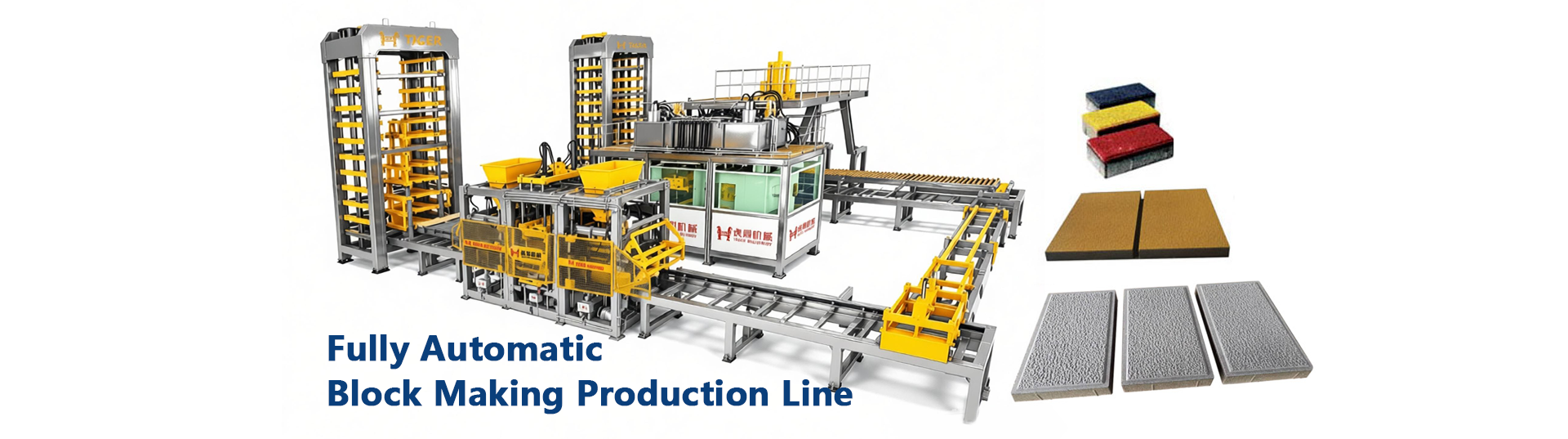
Une machine de fabrication de blocs creux sert d'équipement de construction clé, et il fabrique efficacement des blocs de béton creux de haute qualité pour la construction de murs, trottoirs et autres structures. Ces blocs se distinguent par leur légèreté, forte durabilité et faible coût, et la marque Tiger affine cette machine pour booster ses performances globales et sa fiabilité au quotidien.
Étapes de travail de base de la machine de fabrication de blocs creux
Étape 1: Préparation et mélange des matières premières
Cette machine de fabrication de blocs creux suit quatre, étapes séquentielles pour terminer la production. Avant tout, le processus commence par le mélange des matières premières. Les travailleurs mélangent le ciment, sable, gravier et eau dans des proportions exactes, et même le mélange détermine directement la résistance finale de chaque bloc de béton. De plus, cette première étape jette les bases de toutes les étapes de production ultérieures.
Les modèles de la marque Tiger sont livrés avec des mélangeurs intégrés haut de gamme. Spécifiquement, ces mélangeurs remuent les matières premières complètement et uniformément, ils créent ainsi une base cohérente pour une production de blocs creux de premier plan. Par conséquent, aucune tache inégale ne se forme dans le mélange, et cela réduit finalement les blocs finis défectueux. En plus, la conception avancée du mélangeur des machines Tiger garantit une stabilité à long terme pendant un fonctionnement continu.
Étape 2: Processus d'alimentation et de moulage
Après avoir terminé le mélange des matières premières, la deuxième étape est l'alimentation et le moulage compact. Un système d’alimentation dédié déplace les matières premières mélangées directement dans le moule de la machine. Entre-temps, la machine de fabrication de blocs creux combine une forte pression hydraulique et des vibrations constantes pour presser fermement le mélange dans la forme du moule défini. Cette double action garantit que le mélange adhère étroitement aux contours du moule.
Il utilise des tiges intérieures fixes pour former l'espace creux standard à l'intérieur de chaque bloc.. Surtout, Les machines Tiger permettent aux utilisateurs de régler librement la force des vibrations. Cet ajustement garantit que les matériaux remplissent chaque coin du moule et chassent complètement toutes les bulles d'air emprisonnées.. En outre, la fonction de vibration réglable rend la machine adaptable à différentes consistances de matières premières.
Étape 3: Démoulage doux pour protéger l'intégrité du bloc
Une fois le processus de moulage terminé, la troisième étape est un démoulage doux. La machine applique une force hydraulique contrôlée pour pousser les blocs finis hors du moule.. Spécifiquement, cela évite les fissures ou les cassures lors de ce processus de démoulage rapide, garder chaque bloc intact et bien formé. En outre, le mécanisme de démoulage est conçu pour être efficace, réduire les temps d'arrêt de production entre les lots.
Étape 4: Durcissement final pour la durabilité
Enfin, la dernière étape est un bon durcissement. Les travailleurs transfèrent les blocs nouvellement fabriqués vers une zone de durcissement spéciale, où les blocs restent à sécher et à durcir complètement sur une période définie. En résumé, cette machine de fabrication de blocs creux fiable rationalise la production de matériaux de construction, et la technologie avancée de Tiger en fait un choix de premier ordre pour les équipes de construction qui ont besoin d'une efficacité constante et de produits en blocs durables.. En plus, l’étape de durcissement est cruciale pour améliorer la solidité à long terme et la résistance à l’usure des blocs.